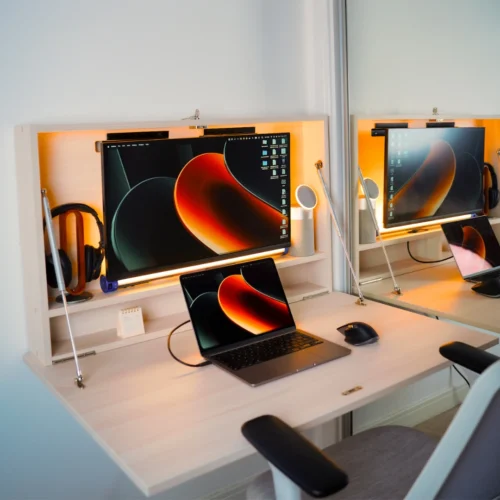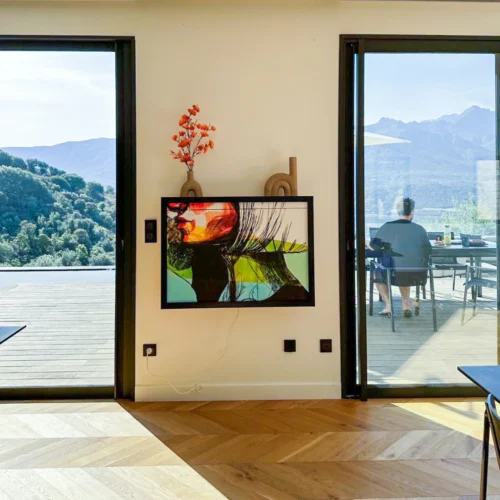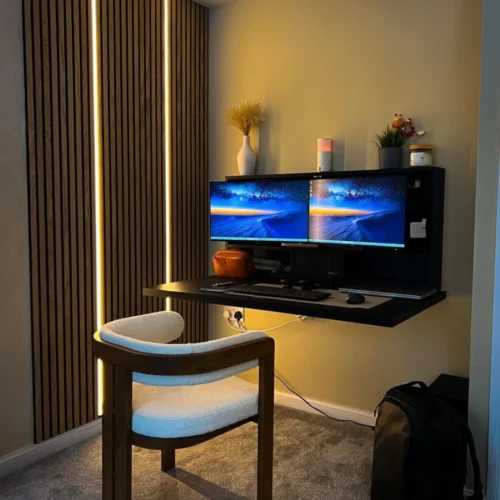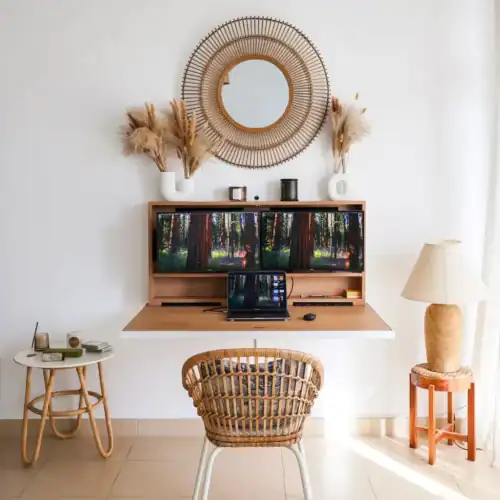
As remote work grows and living spaces shrink in cities everywhere, the fold-away wall desk has become the most logical solution for anyone who wants a real workspace without sacrificing an entire room. But not all fold-away desks are built the same, and the difference between a great experience and a disappointing one comes down to details you might not notice before you buy.
1. Start by measuring your actual available space
Before you think about design or color, measure the wall space precisely: the width, the height from the floor, and the clearance in front of the wall when the desk is fully open. A desk that looks great in a photo can be impractical if the room doesn't allow the chair to slide out comfortably.
- Small room or studio: choose a compact size (around 90–100 cm wide) that fits a laptop and one monitor.
- Dedicated home office: go bigger (110 cm or more) to support two monitors and a printer.
- Hallway or living-room corner: look for a model that folds to a very shallow depth (under 20 cm) so it doesn't block foot traffic when closed.
2. Check the folded depth
The whole point of a wall desk is that it disappears completely when not in use. High-quality desks fold down to just 15–20 cm deep, while lower-quality models stay bulky even when closed — defeating the purpose of buying one in the first place.
3. Materials determine how long it lasts
Look for high-density boards (MDF or coated solid wood) thick enough to hold a laptop and monitors without wobbling. The metal hinges — hydraulic or gas-spring — are what determine how smoothly the desk opens and closes over years of daily use. Avoid cheap plastic hinges that wear out within months.
4. Think about installation and locking
Ask how the desk is installed: does it require a professional, or can you mount it yourself with basic tools? And if you have kids at home or store valuables inside the desk, a locking mechanism is worth prioritizing, especially on models with built-in storage.
5. Choose the size based on how you actually work
If you mostly work on a single screen, a compact size is enough. If your work requires two monitors or room for sketching and note-taking, invest in a larger size from the start rather than replacing the desk later.
Golden rule: choose the desk that fits how you work today, with a little room for how you'll work a year or two from now.
Ready to choose your desk?
Explore three DarDesk sizes designed for every kind of space.